DSHS Grant-Funded Learning Path for Texas Health Care Workers

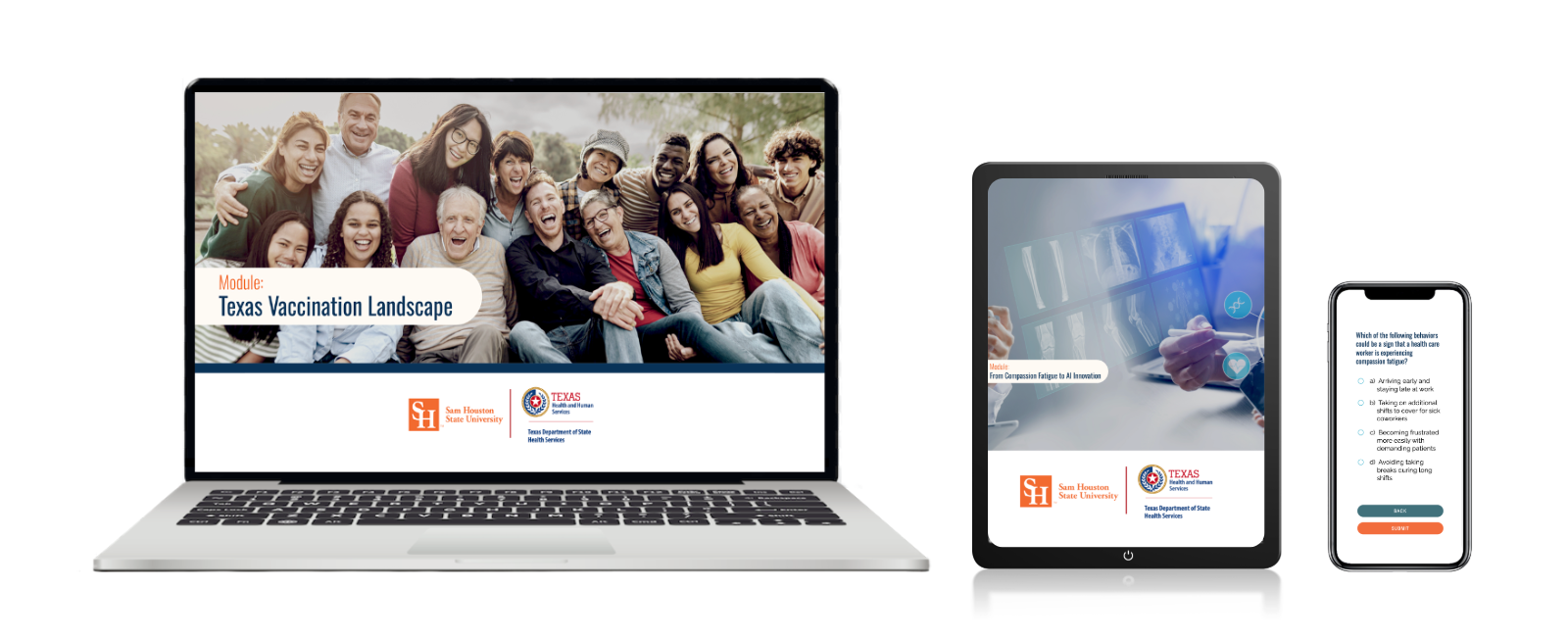
I led the rapid design and development of a multimedia rich three-module CME learning pathway for Texas health care workers on Adobe Captivate 12, transforming dense subject-matter content into three interactive and responsive modules that trained Texas health care professionals in vaccine confidence, motivational interviewing, and resilience strategies using AI.

Role

Senior LXD & Project Lead

Client

Texas Department of State Health Services (DSHS)

Tech

Blackboard Ultra LMS, Video Production

Timeline

May 2023 – Sept. 2024
01. The Challenge
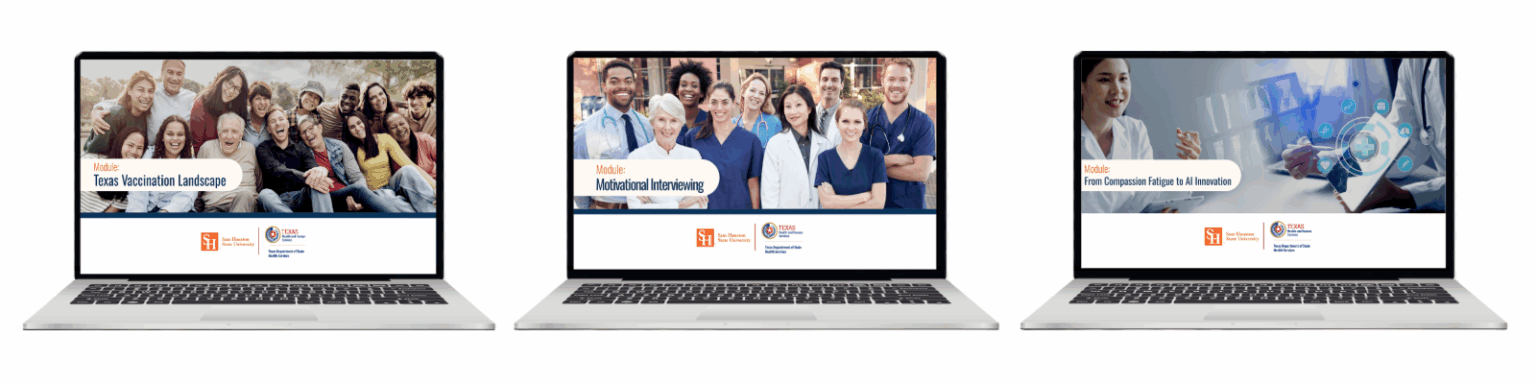
Funded by DSHS, I collaborated with SHSU School of Public Health SMEs to deliver a CME-eligible, three-module pathway—Texas Vaccine Landscape, Motivational Interviewing, and From Compassion Fatigue to AI Innovation—that turns dense policy and clinical material into practical, interactive learning. When Texas policy changes imposed new limits on DEI-related content, the research team had to reframe large portions of the curriculum, compressing the timeline. I stepped in as lead instructional designer and editor, consolidating 300+ slides per module, re-writing and reorganizing content, building activities, assessments, and incorporating high quality graphics and media in Adobe Captivate 12.  I created subtitles and ensured all accessibility and compliance—so the pathway launched accurately, learner-centered, and on time.
The Learning pathway contained three educational modules: Texas Vaccine Landscape, Motivational Interviewing, and From Compassion Fatigue to AI Innovation.

02. Content Reorganization & Slide Redesign

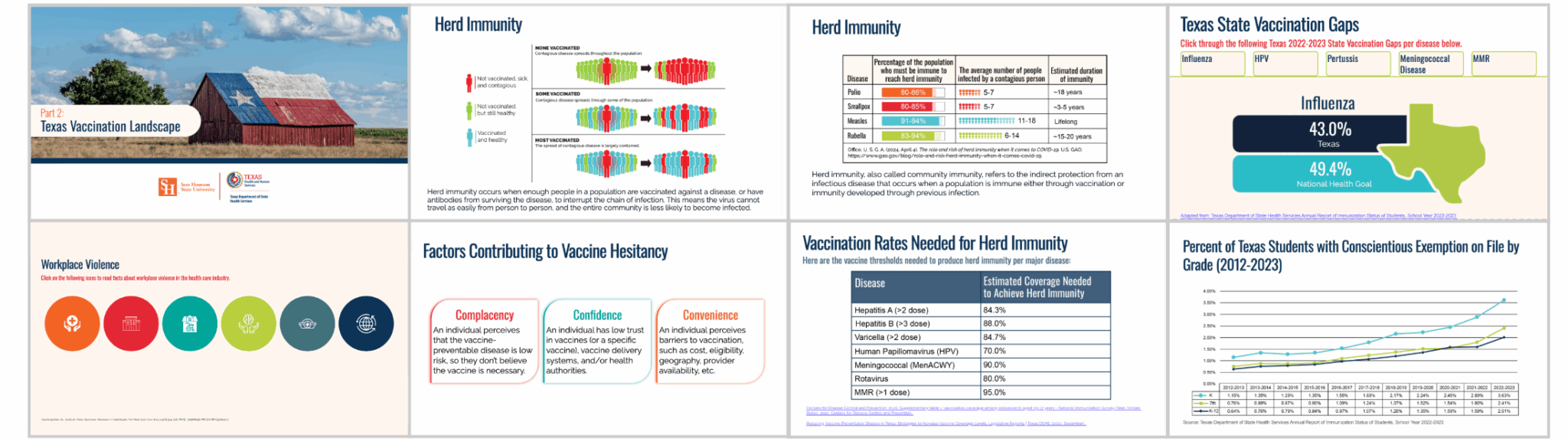
I consolidated and reorganized 300+ SME slides, rewriting scripts and redesigning visualizations to improve clarity, consistency, and accessibility. The final modules adhered closely to the “Texas Your Way” style guidelines, blending high-quality graphics with user-friendly layouts.

03. Iterative Design with SAM

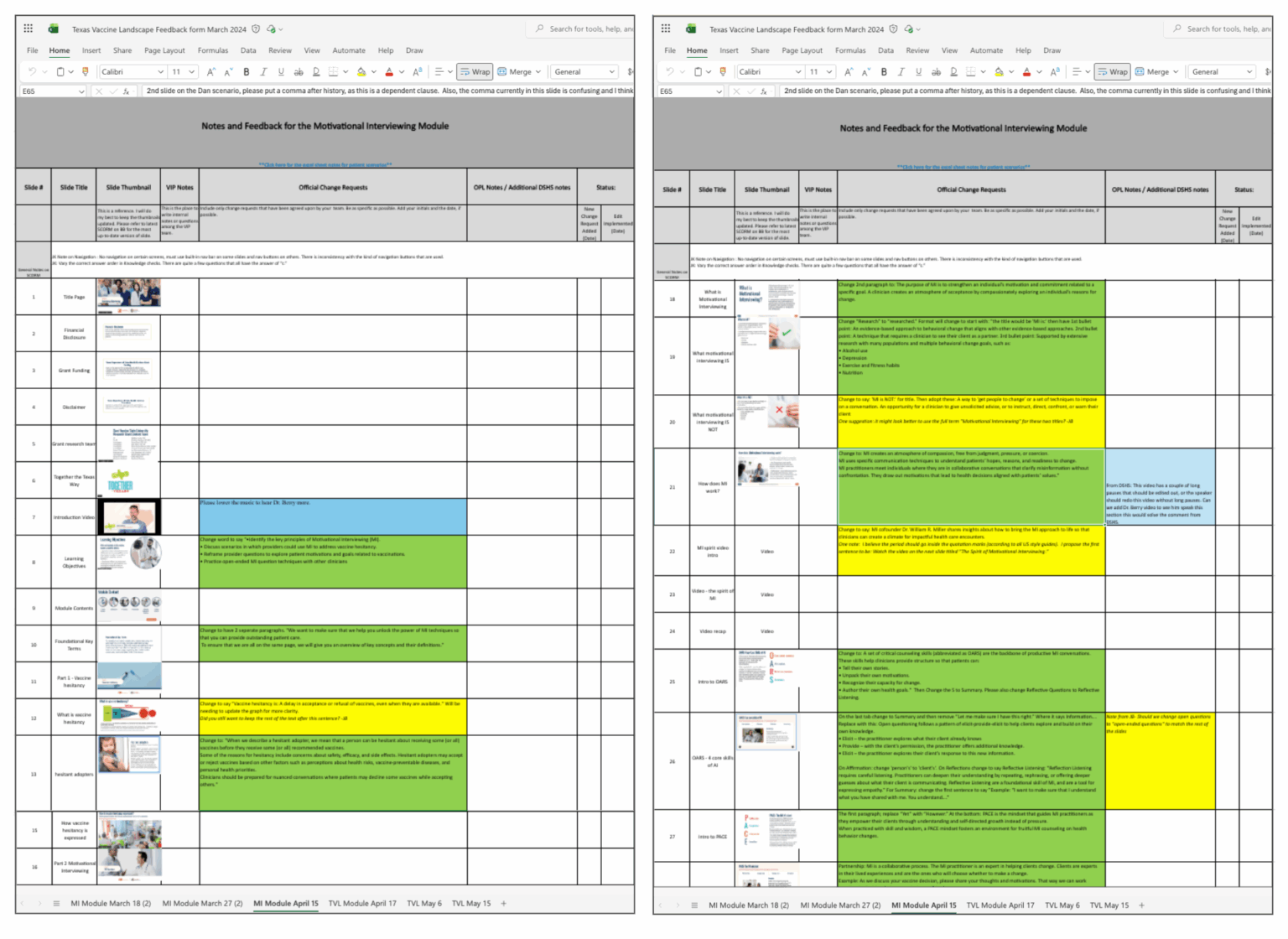
To drive rapid progress, I applied the Successive Approximation Model (SAM), running short design sprints and quickly iterating prototypes. Feedback cycles involved multiple Schools of Public Health and DSHS stakeholders, with input tracked through a centralized Excel feedback system that I designed. This streamlined collaboration and kept all contributors aligned.

Custom feedback form used to capture and organize comments from multiple Schools of Public Health and DSHS stakeholders during each design sprint, which helped streamline rapid SAM design iterations.

04. Interactive Patient Scenarios

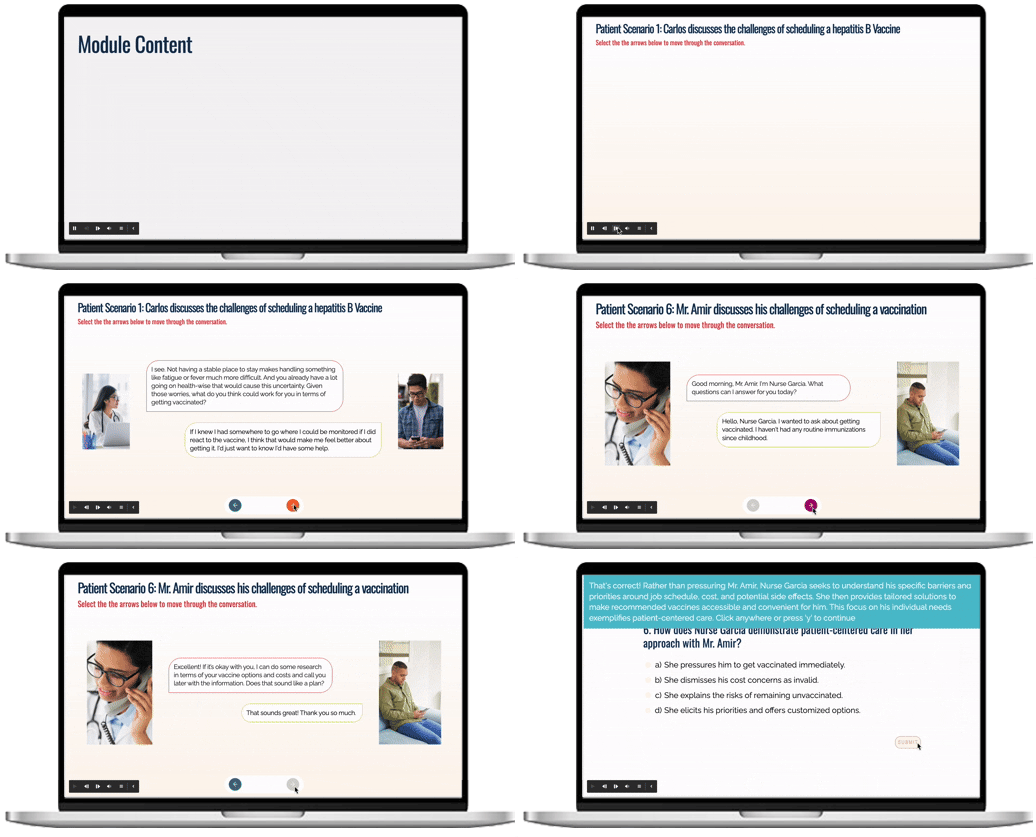
To make dense clinical and policy material actionable, I created a series of interactive patient conversations where learners could click through dialogue bubbles and then answer targeted reflection questions immediately afterward. While not branching, these scenarios required careful scripting, design, and programming to ensure realism and flow. Developing them was highly time-intensive, but the result was a set of engaging, practice-based interactions that reinforced key learning objectives.

Custom scenario-based interactions—tailored for clinicians, community health workers, and auxiliary staff—guided learners through real-world decision-making in activities and assessments.
05. Key Achievements

1.

Led the end-to-end design and development of a multi-module healthcare learning pathway, transforming dense clinical and policy content into engaging, scenario-based training for diverse frontline professionals across Texas — all delivered on an accelerated five-month schedule despite shifting resources and evolving requirements.

2.

Transformed 700+ SME slides into cohesive, accessible modules by rewriting scripts, redesigning charts and graphs to align with state style guidelines, and producing original videos with audio voiceover. I also added subtitles across videos, audio, and slides to ensure accessibility, while enhancing overall clarity and user experience with high-quality graphics and consistent design.
3.

Designed and programmed nearly 80 interactive patient conversations tailored to three professional audiences — clinicians, community health workers, and auxiliary staff. I copy edited all dialogue for clarity and tone, scripted and developed the follow-up questions, and programmed the interactions so learners could click through conversation bubbles and immediately reflect on decisions, reinforcing practice-based skills.